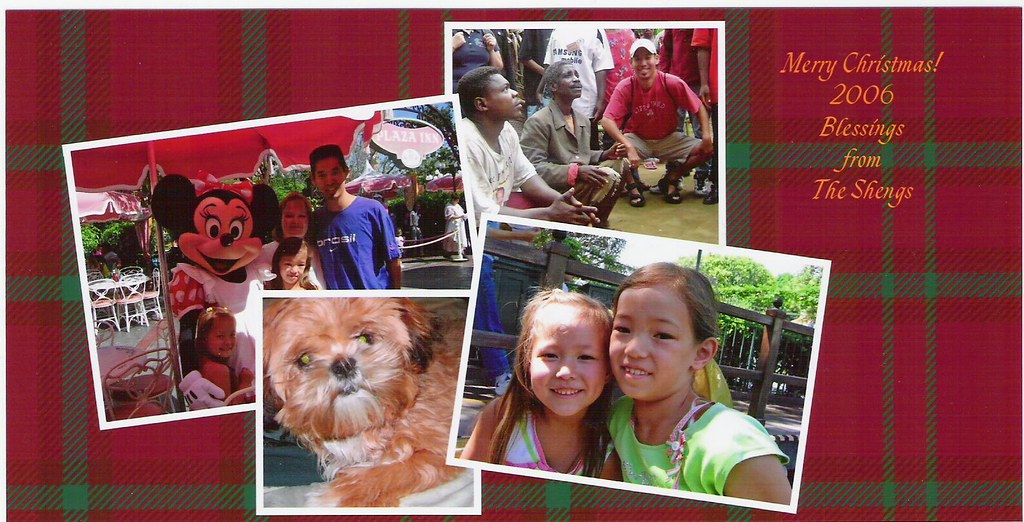
Sunday, December 31, 2006

For 2007

May God bless you with discomfort
at easy answers, half truths, and superficial relationships
so that you may live deep within your heart.

May God bless you with anger
at injustice, oppression and exploitation of people
so that you may work for justice, freedom and peace.

May God bless you with tears
to shed for those who suffer pain, rejection, hunger and war
so that you may reach out your hand to comfort them and
to turn their pain into joy.

And may God bless you with enough foolishness
to believe that you can make a difference in the world
so that you can do what others claim cannot be done
to bring justice and kindness to all our children and the poor.

(A Franciscan Blessing)

via Joel Vestel

Holiday Media

Some of the new, eclectic media around our family this holiday...

Film DVD - Pulp Fiction
Watching this was at the request of Uncle Dug, who got the DVD for Christmas. Yeah yeah, I know - extremely vulgar and violent. But you have to admit, the director was *certainly* trying to say something - "Redemption" is a major theme in the movie. And you must know that Quentin Tarantino [the director] is a huge influence in our culture. More in this article if you are interested - spoiler alert.

CD - Hannah Montana
Overheard on the long drive home:
me - "I'm totally addicted to this CD."
D - "You would be."


CD - Evanescence, The Open Door


Film - Night at the Museum


Music - Christina Aguilera, Back to Basics


Music - Michael W. Smith, Stand


Book - The Journey of Desire, John Eldredge


Book - Planting Churches Cross-Culturally, David Hesselgrave


Remember, relevance to culture is not optional.

2006 in cities

Oops - totally forgot this one and it's one of my favorites... [post is backdated]

1. Fairfield, CT, USA
2. Leesburg, VA, USA
3. Hagerstown, MD, USA
4. Orlando, FL, USA
5. Savannah, GA, USA
6. New York, NY, USA
7. Chincoteague Island, Virginia VA, USA
8. Rehoboth Beach, DE, USA
9. Los Angeles, CA, USA
10. Anaheim, CA, USA
11. Newport Beach, CA, USA
12. Yaounde, Cameroon, Africa
13. Kribi, Cameroon, Africa
14. Paris, France, Europe
15. Gettysburg, PA, USA
16. Annapolis, MD, USA
17. Patapsco State Park, MD, USA
18. Rehoboth Beach, DE, USA
19. Savannah, GA, USA

[Related - 2005 in cities]

Urbana 06 - Missionary Trading

Urbana 06 is going on right now - you can get both the audio and the video from all the sessions as they become available at urbana.org, which is really cool. I've never been, but maybe one of these years I should go.

I've been following a few people who are blogging from the conference. One snippet that intrigues me:
"One practical challenge that Muriu [plenary speaker Oscar Muriu] offered – when American churches send a missionary to the Two-Thirds World, they should also work to receive a missionary from the Two-Thirds World. When churches send a team on a short-term trip, they should likewise receive a team from their partnering church or mission. The North American church must realize how much it needs the life and perspectives of our brothers and sisters around the globe to help us live missionally in our own culture. After all, every part of a human body both gives and receives from others. We are impoverished if we think we have nothing to receive from the majority world church."- Al Hsu, from the Suburban Christian
Sort of like our Reverse Missions idea, but even better. Working out an idea like this would continue to make SPACE one of the most innovative, creative and strategic student missions movements around.

Thursday, December 28, 2006

I could get used to this

It's not much, but I call it a remote office. Tybee Island, GA.

Double Confirmation and a Sense of Destiny

"The classic pattern for double confirmation involves four steps. First there is a crucial moment in the leader's ministry when a sure word from God is needed for direction. Second, God gives direction to the leader directly or indirectly. Third, God then confirms this direction through someone else. Fourth, God brings the two together in some unmistakable, sovereign way.
Double confirmation gives divine affirmation to an important decision and validates a leader's spiritual authority. It gives a renewed sense of destiny to the leader, while serving as a sign to outsiders as well as insiders."

- Bobby Clinton in The Making of a Leader

Your experience?

Wednesday, December 27, 2006

Wednesday Potpourri

::: VBS Ladies
"They can be a blessing, or a source of consternation if they’re given too much authority and allow activities to supersede relationships."
Link from Seth Barnes


::: Youth Ministries for Peace and Justice
Link from Rudy


::: A Biblical Missiology for North American People Groups
Therefore, discipleship of North American people groups is not only a domestic missions agenda but a global one. A biblical missiology that encompasses inclusion, compassion, justice, and proclamation is biblically mandated. If members of people groups are discipled here, many more individuals of unreached people groups can be discipled internationally. As Rajendra K. Pillai boldly states in his book, Reaching the World in our own Backyard: "People from other religions and cultures now live, study, and work among us. They are America’s most overlooked mission field. We cannot make excuses anymore. The eternal destinies of millions are at stake. Remember: If you are not fishing, you are not following!"
Full pdf report from NAMB.net


::: The Delta Scan - A forum for scanning the science and technology horizon over the next 50 years.
There are some amazing outlooks [an internally consistent, plausible view of the future based on the best expertise available - not a prediction or policy or preference] in here, including:
- Studying Human Behavior in Cyberspace
Cyber-ethnography, defined as the study of online interaction, is likely to become an important area of anthropological research as more and more human activites are conducted in cyberspace.
- Application of AI to Global Trade and Logistics
The application of artificial intelligence to commerce may make trade and logistics more efficient.
- Mobile Phones and Economic Growth in the Developing World
Mobile phones have the potential to spur economic growth, especially entrepreneurial business, in the Developing World.
- From Brain Drain to Brain Circulation
The 20th-century phenomenon of 'brain drain', of scientific and engineering talent emigrating from developing countries to North America and Europe, is likely to be replaced by 'brain circulation', in which globally mobile scientists and engineers work for shorter periods in a wider range of countries.
via BoingBoing

Saturday, December 23, 2006

Nine

K turns nine today. That is her running in the annual Pumpkin Run at her school from around Halloween. Keep running girl, the world needs you.

Friday, December 22, 2006

On the Move

We are on the move to Savannah for the Christmas holiday. Should be a fun time. Blessings and Merry Christmas to you and your families.

ps - My house is being guarded by one very dangerous housesitter and two very smart dogs.

Photo: K on her new bike she got for her birthday.

Thursday, December 21, 2006

Wednesday, December 20, 2006

Tuesday Potpourri

::: 70
Paralyzed making a decision as a leader? The Marine Corps trains officers to make decisions when they are 70 percent confident of the outcome.
A template for looking at some of the most commonly encountered problems in reaching a decision from Leading Blog.


::: 80
We often fear letting go of things because of someone who will do it as good as us. But, as Maxwell has said, if someone can do it 80% as good as you--let go. When we don’t let things go, not only do we deprive others of getting in the game, but we also don’t get to grow on to new levels of impact ourselves.
7 points about developing leaders from NorthWood Church.


:::The top 5 most dangerous roads in the world
Link via kottke


::: Virgin Komodo Dragon to Give Birth
See, it could happen. Merry Christmas!

Tuesday, December 19, 2006

My Blog Updates to Your Phone?

I'm going to try to enable this very soon. [RSS readers - there is an embedded video in this post.]

via Waxy.org [For some really strange reason, my wife didn't think it was half as funny as I did.]

Monday, December 18, 2006

The End of Poverty - Chapter 3

The third post in a series of posts based on the book The End of Poverty. [Notes from Chapter 1 and Chapter 2.]

Chapter Three - Why Some Countries Fail to Thrive
Eight major categories of problems can cause an economy to stagnate or decline:

1. The Poverty Trap
Poor do not have the ability by themselves to get out of it - too poor to save for the future.

2. Physical Geography
Americans, for example, believe that they earned their wealth all by themselves. They forget that they inherited a vast continent rich in natural resources, with great soils and ample rainfall, immense navigable rivers and thousands of miles of coastline with dozens of natural ports that provide a wonderful foundation for sea-based trade.
Many of the world's poorest countries are severely hindered by high transport costs because they are landlocked; situated in high mountain ranges; or lack navigable rivers, long coastlines or good natural harbors. Culture does not explain the persistence of poverty in Bolivia, Ethiopia, Kyrgyzstan or Tibet. Look instead to the mountain geography of a landlocked region facing crushing transport costs and economic isolation that stifle almost all forms of modern economic activity.
Sub-Saharan Africa, in particular, has an ideal rainfall, temperature and mosquito type that make it the global epicenter of malaria, perhaps the greatest factor in slowing Africa's economic development throughout history.
Fortunately, none of these conditions is fatal to economic development. It's time to banish the bogeyman of geographical determinism, the false accusation that claims about geographical disadvantage are also claims that geography single-handedly and irrevocably determines the economic outcome of nations.

3. Fiscal Trap
Even when the private economy is not impoverished, the government may lack the resources to pay for the infrastructure on which economic growth depends. Governments are critical to investing in public goods and services like primary health care, roads, power grids, ports and the like.

4. Governance Failures
Economic development requires a government oriented toward development.

5. Cultural Barriers
Cultural or religions norms in the society may block the role of women, for example, leaving half of the population without economic or political rights and without education, thereby undermining half of the population in its contribution to overall development.
6. Geopolitics
Trade barriers erected by foreign countries can impede a poor country's economic development.

7. Lack of innovation
Consider the plight of inventors in an impoverished country. Even if inventors are able to develop new scientific approaches to meet local economic needs, the chances of recouping investments in research and development through later sales in the local market are very low.
Rich countries have a big market, which increases the incentive for innovation, brings new technologies to market, further raises productivity and expands the size of the market, and creates new incentives for innovation. This momentum creates, in effect, a chain reaction, which economists call endogenous growth. Innovation raises the size of the market; a larger market raises the incentives for innovation. Therefore, economic growth and innovation proceed in a mutually reinforcing process.
8. The Demographic Trap
Half the world, including all of the rich world, is at or near the so-called replacement rate of fertility, in which each mother is raising one daughter on average to replace her in the next generation.
One reason for a poverty trap is a demographic trap, when impoverished families choose to have lots of children. These choices are understandable, yet the results can be disastrous. When impoverished families have large numbers of children, the families cannot afford to invest in the nutrition, health and education of each child.


My thoughts:
- The problem of extreme poverty is much larger than any one idea or thought.
- This chapter is set up for more of the concrete and tangible solutions later in the book. Look for my notes on those in a few weeks - my library copy of the book can't be renewed anymore.
- The paragraph about Americans "forget[ing] that they inherited a vast continent" was sobering. I never thought about it that way before. Gives even more weight to the idea that we have been blessed to be a blessing.

Saturday, December 16, 2006

December Convergence

When we are the epicenter of a community that resources, trains and sends people back and forth from culture to culture, December can be an amazing convergence. Friends from near and far dropped in last night.

Photo: Some of the Cam team with Tkshi from Yaounde, Cameroon.

Friday, December 15, 2006

storiesfromcpr.blogspot.com

A place where you all can comment and share your stories about your friends, people and making an impact on the world. Click.

Friday Potpourri

:::Alan Hirsch on the fringe
In the study of the history of missions, one can even be formulaic about asserting that all great missionary movements begin at the fringes of the church, among the poor and the marginalized, and seldom, if ever, at the center. It is vital that in pursuing missional modes of church, we get out of the stifling equilibrium of the center of our movements and denominations, move to the fringes, and engage in real mission there. But there’s more to it than just mission; most great movements of mission have inspired significant and related movements of renewal in the life of the church. It seems that when the church engages at the fringes, it almost always brings life to the center. This says a whole lot about God and gospel, and the church will do well to heed it.
Link to download the intro and chapter 1 of his new book.


:::Soul Surfing School via the YS Student Newsletter


:::Donate Your USB drives to Africa
Inveneo is a non-profit that brings information and communication technology to remote and rural ares in the developing world. We're holding a Thumb Drive Drive. Donate old USB thumb drives (16mb and larger) so that they can be provided to school labs in the countries where we operate including Uganda, Rwanda, and Mali. Low capacity thumb drives are the AOL floppies of the 2000s. We'd like to put them to good use. Donations are tax deductible.
Link via BoingBoing